







Metal detection: building the detector
IntroductionBefore starting, you may want to read this post describing the BFO stage:
//www.embeddedrelated.com/showarticle/911.php
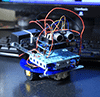
I have detailed the implementation of a BFO stage for detecting metal. Now it has been validated on the bench, the next step is to integrate it in a stand alone instrument for testing on the field. A few things have to be done to reach this goal:
- make a PCB for the electronics,
- house the PCB in a box,
- add a power supply,
- make a frame to hold...
Basic hand tools for electronics assembly

Though the software tools vary with different microcontrollers, many hardware tools are the same.
Improving the Reload2 active load
IntroductionWith another colleague at work, we are currently developing an electronic board that will eventually be powered over Ethernet. To gain more experience with this technology, we prototyped a standalone power supply stage.
We want to test this stage with different load profiles. While we already have professional grade active loads at work, I had previously read about the Reload2 product from Arachnidlabs, a low cost active load sold on Hackaday:
OOKLONE: a cheap RF 433.92MHz OOK frame cloner
IntroductionA few weeks ago, I bought a set of cheap wireless outlets and reimplemented the protocol for further inclusion in a domotics platform. I wrote a post about it here:
//www.embeddedrelated.com/showarticle/620.php
Following that, I had access to another outlet from a different vendor:
http://www.castorama.fr/store/Prise-telecommandee-BLYSS---Interieur-prod4470027.html
The device documentation mentions that it operates on the same frequency as the previous...
Practical protection against dust and water (i.e. IP protection)

Recently, I was faced with a challenge to provide IP65 compliance in a product that had to have humidity and pressure sensors on it. The tricky part was to keep the cost of the unit under $15 while meeting this requirement.
Under normal circumstances, one can put all the electronics within an IP65 enclosure that is affordable and readily available off-the-shelf most of the time such as the ones shown in this link. However, given the humidity and the pressure sensor need to be exposed to...
A wireless door monitor based on the BANO framework
IntroductionI have been thinking for a while about a system to monitor the states of my flat and my garage doors from a remote place. Functionnaly, I wanted to monitor the state of my doors from a remote place. A typical situation is when I leave for holidays, but it can also be useful from the work office. To do so, I would centralize the information on a server connected on the Internet that I could query using a web browser. The server itself would be located in the appartement, where...
Using the Beaglebone PRU to achieve realtime at low cost
IntroductionI work as an engineer in a synchrotron facility. A few weeks ago, I helped the people in charge of the power supply developments to integrate a realtime control algorithm on a prototype platform: a BeagleBone Black (BBB) running Linux. I had already worked with this board in the past, and I found it very interesting given its excellent resources versus price ratio (around 40 euros). This time, I was impressed by its realtime capabilities. I thought it would be a good idea to...
A simple working I2C (TWI) level shifter
Recently, I had to interface two hardware platforms via an I2C bus (a.k.a. two-wire interface, TWI) to query temperature and real-time clock information. This task is relatively straightforward on the software side. However, because the power supply of the two platforms were different (one at 3.3V and the other at 5V), the I2C busses could not be connected to one another directly and a level shifter was required between them.
There are commercially available I2C level shifters such as...
Requirements, Specifications and Tests

As a freelance developer of all things embedded, it's important that right through a project everyone involved knows what is expected, who is responsible for delivering, and how to confirm that what is delivered meets the customers expectations.
I have a tried and trusted method that works for me each time, is flexible enough to deal with feature-creep and solid enough to give the client that warm fuzzy fealing that they crave.
I've dound that this method of working has in the past been...
Layout recomendations and tips for best performance against EMC

When making the layout of the circuit diagram, it is interesting to perform a preliminary analysis of several issues in order to minimize problems arising from electromagnetic compatibility.The analysis consists in:
Identify / Analyze components: This section will analyze the integrated components, as well as any recommendations it may have the manufacturer. We must also analyze the encapsulation possibilities which have the component.
3 Overlooked Embedded Software Elements

Have you ever wondered, while you and your team are busy writing software if the foundation of how embedded software systems are built has changed and left you in the dust? What if while you were busily focusing on getting your product out the door, fighting bugs, and dealing with supply issues, there were techniques and processes that you completely overlooked that could save the day? I’ve found three elements embedded software teams often underutilize that could dramatically improve...
Video-Based STEM Embedded Systems Curriculum, Part 1
Contents:
- Introduction
- Adapting To Your Circumstances
- Suggested Policies
- The Video Educators
- Equipment, Books, and Supplies
- Lesson Summary
- Suggested Teaching Method
A wireless door monitor based on the BANO framework
IntroductionI have been thinking for a while about a system to monitor the states of my flat and my garage doors from a remote place. Functionnaly, I wanted to monitor the state of my doors from a remote place. A typical situation is when I leave for holidays, but it can also be useful from the work office. To do so, I would centralize the information on a server connected on the Internet that I could query using a web browser. The server itself would be located in the appartement, where...
Practical protection against dust and water (i.e. IP protection)
Recently, I was faced with a challenge to provide IP65 compliance in a product that had to have humidity and pressure sensors on it. The tricky part was to keep the cost of the unit under $15 while meeting this requirement.
Under normal circumstances, one can put all the electronics within an IP65 enclosure that is affordable and readily available off-the-shelf most of the time such as the ones shown in this link. However, given the humidity and the pressure sensor need to be exposed to...
A simple working I2C (TWI) level shifter
Recently, I had to interface two hardware platforms via an I2C bus (a.k.a. two-wire interface, TWI) to query temperature and real-time clock information. This task is relatively straightforward on the software side. However, because the power supply of the two platforms were different (one at 3.3V and the other at 5V), the I2C busses could not be connected to one another directly and a level shifter was required between them.
There are commercially available I2C level shifters such as...
First Steps in OrCAD 16 [Capture]
Hello community, I know that in last posts I have been writting about the Software. But what about Hardware? In last months I have been dealing with it, exactly with OrCAD 16. And I will explain how to build a PCB in 2 articles. For begginers could be a good and easy guide.
This article explains the part for the designing of the schematic, and in the next one which i will explain the layout part.
The first stuff you must known about OrCAD is that it is not an unique tool for...
Metal detection: building the detector
IntroductionBefore starting, you may want to read this post describing the BFO stage://www.embeddedrelated.com/showarticle/911.php
I have detailed the implementation of a BFO stage for detecting metal. Now it has been validated on the bench, the next step is to integrate it in a stand alone instrument for testing on the field. A few things have to be done to reach this goal:
- make a PCB for the electronics,
- house the PCB in a box,
- add a power supply,
- make a frame to hold...
Bringing up Baby - product development thoughts

Things have just started to get exciting. After months of defining, specifying and designing my latest product, I finally have semi-functional prototypes. After a few side steps during the building and bring-up process, power is applied and most of the low level functions have been verified. Soon, software will meet hardware and debugging can begin in earnest.
Before jumping in and really enjoying the fun (besides I'm now waiting for some new parts to arrive), I thought it would be nice to...
Review: Prototype to Product
Prototype to Product: A Practical Guide for Getting to Market, by Alan Cohen, is a must-read for anyone involved in product development, whether in a technical, management, or executive role.
I was reminded of it by Cohen's recent episode on Embedded.fm, 388: Brains Generate EMF, which is worth listening to a couple times through, especially if you're interested in medical device development. And in fact his first episode there,
Introducing The VolksEEG Project
IntroductionThe VolksEEG project is an open-source project with the goal of creating an electroenchephalogram (EEG) machine, fully cleared by the FDA for standard clinical use. All designs will be freely available for others to manufacture.
The project was founded by Alan Cohen, a medical device systems engineer with an electrical engineering/software (EE/SW) background in Boston, USA, and Dr. Bryan Glezerson
Improving the Reload2 active load
IntroductionWith another colleague at work, we are currently developing an electronic board that will eventually be powered over Ethernet. To gain more experience with this technology, we prototyped a standalone power supply stage.
We want to test this stage with different load profiles. While we already have professional grade active loads at work, I had previously read about the Reload2 product from Arachnidlabs, a low cost active load sold on Hackaday:
A simple working I2C (TWI) level shifter
Recently, I had to interface two hardware platforms via an I2C bus (a.k.a. two-wire interface, TWI) to query temperature and real-time clock information. This task is relatively straightforward on the software side. However, because the power supply of the two platforms were different (one at 3.3V and the other at 5V), the I2C busses could not be connected to one another directly and a level shifter was required between them.
There are commercially available I2C level shifters such as...
Deeply embedded design example - Logic replacement
I have always believed that some of the low-cost, low-pin count, low-resource microprocessors would make an excellent choice for the replacement of discrete logic components. In these cases the deeply embedded microprocessor would become less of a general purpose computer and more of a logic replacement, providing a prescribed function with no connection to the outside world. In a world of bigger, faster and more expensive, it is a pleasant change of pace...
3 Overlooked Embedded Software Elements
Have you ever wondered, while you and your team are busy writing software if the foundation of how embedded software systems are built has changed and left you in the dust? What if while you were busily focusing on getting your product out the door, fighting bugs, and dealing with supply issues, there were techniques and processes that you completely overlooked that could save the day? I’ve found three elements embedded software teams often underutilize that could dramatically improve...
Metal detection: building the detector
IntroductionBefore starting, you may want to read this post describing the BFO stage://www.embeddedrelated.com/showarticle/911.php
I have detailed the implementation of a BFO stage for detecting metal. Now it has been validated on the bench, the next step is to integrate it in a stand alone instrument for testing on the field. A few things have to be done to reach this goal:
- make a PCB for the electronics,
- house the PCB in a box,
- add a power supply,
- make a frame to hold...
Video-Based STEM Embedded Systems Curriculum, Part 1
Contents:- Introduction
- Adapting To Your Circumstances
- Suggested Policies
- The Video Educators
- Equipment, Books, and Supplies
- Lesson Summary
- Suggested Teaching Method
Practical protection against dust and water (i.e. IP protection)
Recently, I was faced with a challenge to provide IP65 compliance in a product that had to have humidity and pressure sensors on it. The tricky part was to keep the cost of the unit under $15 while meeting this requirement.
Under normal circumstances, one can put all the electronics within an IP65 enclosure that is affordable and readily available off-the-shelf most of the time such as the ones shown in this link. However, given the humidity and the pressure sensor need to be exposed to...
Introducing The VolksEEG Project
IntroductionThe VolksEEG project is an open-source project with the goal of creating an electroenchephalogram (EEG) machine, fully cleared by the FDA for standard clinical use. All designs will be freely available for others to manufacture.
The project was founded by Alan Cohen, a medical device systems engineer with an electrical engineering/software (EE/SW) background in Boston, USA, and Dr. Bryan Glezerson
Make Your Own MCU Boards (2023 Teardown Conference)

Ditch the development boards! Products like the Nucleo development boards serve a wonderful purpose, but they’re ill-suited for projects that need to be small and cheap, such as hobby projects or products just beginning a production run. In this talk (a recording from the 2023 Teardown Conference), you’ll learn how to put a microcontroller or other custom circuit on a PCB a little larger than a stick of gum for less than $3 a board.
Software Prototyping
In my recent blog entry on the product development process (way down, near the end of the entry), I wrote the following:
"I continue these sorts of tests, building more and more complexity, until I am satisfied that my circuit is basically functional. Then, using the test code that I have created as a model, I begin to write the real software for my product. As my software grows, to complete the full functionality of my design, I sometime find it useful to drop back to my 'test software'...