




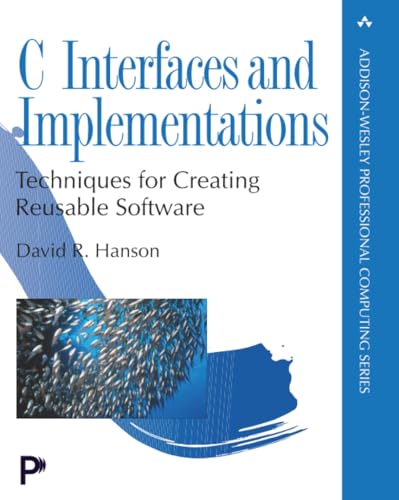
C Interfaces and Implementations: Techniques for Creating Reusable Software (Addison-Wesley Professional Computing Serie
creating reusable software modules; they are the building blocks of large, reliable applications. Unlike some modern object-oriented languages, C provides little linguistic support or motivation for creating reusable application programming interfaces (APIs). While most C programmers use APIs and the libraries that implement them in almost every application they write, relatively few programmers create and disseminate new, widely applicable APIs. C Interfaces and Implementations shows how to create reusable APIs using interface-based design, a language-independent methodology that separates interfaces from their implementations. This methodology is explained by example. The author describes in detail 24 interfaces and their implementations, providing the reader with a thorough understanding of this design approach. Features of C Interfaces and Implementations: * Concise interface descriptions that comprise a reference manual for programmers interested in using the interfaces. * A guided tour of the code that implements each chapters interface tp help those modifying or extending an interface or designing related interfaces. * In-depth focus on algorithm engineering: how to packag
Why Read This Book
You will learn how to design C APIs that are clear, robust, and reusable across projects and platforms, using a language-independent interface-based methodology. The book gives concrete, production-tested patterns and full implementations so you can apply the techniques immediately to firmware, libraries, and embedded system code.
Who Will Benefit
Experienced C developers and embedded/firmware engineers who need to design modular, maintainable APIs and reusable libraries for constrained or cross-platform systems.
Level: Advanced — Prerequisites: Solid C programming (pointers, structs, function pointers), familiarity with build/link processes (make, static/shared libs), and basic data structures and debugging tools.
Key Takeaways
- Design clean C interfaces that separate API from implementation and minimize coupling
- Implement opaque types, handle-based modules, and encapsulation idioms suitable for C
- Apply consistent ownership and memory-management conventions to avoid leaks and bugs
- Build reusable container, iterator, and callback-based modules with clear contracts
- Package, document, and version C libraries for reuse across projects and platforms
- Adapt API and implementation choices to embedded constraints (size, performance, portability)
Topics Covered
- Introduction: Why interfaces matter in C
- Principles of interface-based design
- Header-file conventions and public/private separation
- Opaque types, handles, and encapsulation idioms
- Memory management and ownership policies
- Iterators, callbacks, and traversal patterns
- Common reusable modules: stacks, queues, lists, tables, sets, and maps
- Generic programming techniques and macro-based abstraction
- Error handling, assertions, and defensive programming
- Testing, debugging, and documenting interfaces
- Packaging, linking, and versioning reusable libraries
- Case studies: 24 interfaces and their implementations
- Appendices: style, portability, and migration strategies
Languages, Platforms & Tools
How It Compares
Compared with K&R's The C Programming Language (which teaches core syntax and idioms), Hanson's book focuses specifically on API design and reusable-module implementations; compared to books like "Design Patterns in C", it emphasizes concrete, fully worked C implementations and practical packaging for real projects.