





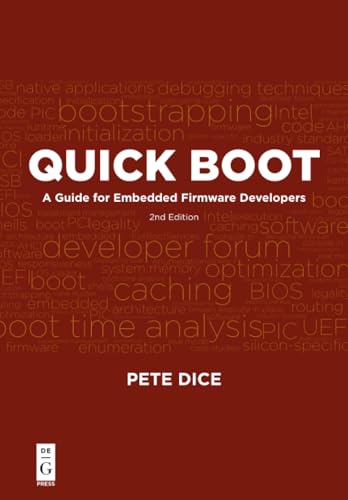
Quick Boot: A Guide for Embedded Firmware Developers, 2nd edition
Quick Boot is designed to give developers a background in the basic architecture and details of a typical boot sequence. More specifically, this book describes the basic initialization sequence that allows developers the freedom to boot an OS without a fully featured system BIOS. Various specifications provide the basics of both the code bases and the standards. This book also provides insights into optimization techniques for more advanced developers. With proper background information, the required specifications on hand, and diligence, many developers can create quality boot solutions using this text. is designed to give developers a background in the basic architecture and details of a typical boot sequence. More specifically, this book describes the basic initialization sequence that allows developers the freedom to boot an OS without a fully featured system BIOS. Various specifications provide the basics of both the code bases and the standards. This book also provides insights into optimization techniques for more advanced developers. With proper background information, the required specifications on hand, and diligence, many developers can create quality boot solutions using this text.
Why Read This Book
You will learn the step-by-step architecture and low-level details of a typical boot sequence so you can build or customize a minimal, reliable boot solution without relying on a full system BIOS. The book mixes practical implementation guidance with optimization techniques for faster, smaller, and more secure boot flows, making it a hands-on reference when you need to bring up hardware and hand off to an OS.
Who Will Benefit
Firmware engineers, embedded Linux integrators, bootloader authors, and systems programmers with some low-level experience who need to implement or optimize boot sequences and OS handoff on ARM, RISC-V, or x86 targets.
Level: Intermediate — Prerequisites: Familiarity with C and some assembly, basic CPU architecture (ARM/x86/RISC-V), knowledge of memory and peripheral concepts, and experience reading datasheets and using toolchains (GCC/binutils).
Key Takeaways
- Describe the staged boot model and design boot stages (ROM, first-stage, second-stage) appropriate to your platform.
- Implement the minimal initialization required for CPU, memory, and essential peripherals to hand control to an OS or bootloader.
- Integrate and adapt common boot components (device trees, early console, flash/mass-storage drivers) for embedded targets.
- Optimize boot time and size through targeted initialization, caching/MMU strategies, and binary layout techniques.
- Apply secure-boot and integrity-checking concepts to establish a trusted boot chain for firmware and OS images.
- Use common debug and test workflows (QEMU, JTAG/OpenOCD, serial consoles, and symbol-aware debugging) to diagnose early boot problems.
Topics Covered
- Introduction: What a Boot Sequence Is and Why It Matters
- Boot Models and Staging: ROM, First-Stage, and Second-Stage Loaders
- CPU Startup: Reset Vectors, Exception Levels, and Early Mode Setup
- Memory Initialization: DRAM Controllers, RAM Training, and MMU Setup
- Clocks, Power, and Peripheral Bring-up
- Storage and Image Formats: Flash, SD, eMMC, and Filesystems
- Device Trees, Firmware Tables, and Hardware Description
- Loading Code: Flashing, Chainloading, and Kernel/Image Placement
- OS Handoff: Kernel Entry Conventions and Passing Boot Parameters
- Debugging Early Boot: Serial, JTAG, QEMU, and Trace Techniques
- Optimization Techniques: Reducing Latency, Size, and Power
- Security and Trust: Signatures, Secure Boot, and Measured Boot
- Case Studies: Minimal Boot for Embedded Linux, RTOS, and Bare-Metal
- Appendices: Useful Tools, Binary Formats, and Reference Specifications
Languages, Platforms & Tools
How It Compares
Compared with Vincent Zimmer's 'Beyond BIOS' (UEFI-focused) and typical U-Boot/GRUB guides, Quick Boot emphasizes minimalist, practical boot sequences and low-level optimization rather than full UEFI stacks or heavy bootloaders.