Embedded SoPC Design with Nios II Processor and VHDL Examples
The book is divided into four major parts. Part I covers HDL constructs and synthesis of basic digital circuits. Part II provides an overview of embedded software development with the emphasis on low-level I/O access and drivers. Part III demonstrates the design and development of hardware and software for several complex I/O peripherals, including PS2 keyboard and mouse, a graphic video controller, an audio codec, and an SD (secure digital) card. Part IV provides three case studies of the integration of hardware accelerators, including a custom GCD (greatest common divisor) circuit, a Mandelbrot set fractal circuit, and an audio synthesizer based on DDFS (direct digital frequency synthesis) methodology.
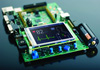
The book utilizes FPGA devices, Nios II soft-core processor, and development platform from Altera Co., which is one of the two main FPGA manufactures. Altera has a generous university program that provides free software and discounted prototyping boards for educational institutions (details at http://www.altera.com/university). The two main educational prototyping boards are known as DE1 ($99) and DE2 ($269). All experiments can be implemented and tested with these boards. A board combined with this book becomes a “turn-key” solution for the SoPC design experiments and projects. Most HDL and C codes in the book are device independent and can be adapted by other prototyping boards as long as a board has similar I/O configuration.
Why Read This Book
You will get a hands-on, example-driven path to building FPGA-based systems-on-a-programmable-chip (SoPC) using the Nios II soft processor and VHDL; the book walks you from HDL basics through device drivers, complex I/O peripherals, and real hardware-accelerator case studies so you can deliver full hardware/software co-designs on Altera/Intel FPGAs.
Who Will Benefit
Embedded engineers or advanced students with some digital-design and C programming background who want to build real SoPCs with Nios II, implement custom peripherals in VHDL, and integrate hardware accelerators into firmware.
Level: Intermediate — Prerequisites: Basic digital logic and finite-state machines, introductory VHDL familiarity, C programming for embedded systems, and basic familiarity with FPGAs and toolchains (Quartus/ModelSim recommended).
Key Takeaways
- Implement common HDL constructs and synthesize combinational and sequential circuits for FPGAs using VHDL.
- Configure and use the Nios II soft-core toolchain and SOPC/Qsys flow to build a complete SoPC.
- Write low-level device drivers and perform memory-mapped I/O and interrupt handling for Nios II firmware.
- Design and integrate complex peripherals (PS/2 keyboard/mouse, VGA/graphics controller, audio codec, SD card interface) in hardware and driver software.
- Create hardware accelerators (GCD, Mandelbrot fractal, DDFS audio synthesizer) and integrate them with the processor for performance gains.
- Debug and validate hardware/software integration using simulation and FPGA development tools.
Topics Covered
- Part I: VHDL and Digital Design Fundamentals — HDL constructs, data types, and synthesis
- Combinational and Sequential Logic — gates, arithmetic, state machines, timing
- FPGA Implementation and Synthesis — constraints, resource mapping, and optimization
- Part II: Nios II and Embedded Software Basics — architecture, toolchain, and BSPs
- Low-Level I/O and Driver Development — memory-mapped I/O, interrupts, and DMA basics
- Part III: Peripheral Hardware/Software Designs — PS/2 keyboard and mouse interface
- Part III (cont.): Video and Graphics Controller Design — VGA/graphics implementations
- Part III (cont.): Audio Codec and SD Card Interfaces — audio capture/playback and SD card I/O
- Part IV: Hardware Accelerators and Co-Design — GCD accelerator and integration
- Part IV (cont.): Mandelbrot Fractal Accelerator — design and host interface
- Part IV (cont.): DDFS Audio Synthesizer — digital frequency synthesis in hardware
- Case Studies, System Integration, and Performance Analysis
- Appendices: Quartus II/SOPC Builder/Nios II tool usage, simulation examples, and suggested lab exercises
Languages, Platforms & Tools
How It Compares
Compared with Pong P. Chu's FPGA Prototyping books, this title emphasizes SoPC/processor-centric design and hardware/software integration around the Nios II; compared to general FPGA system-design texts (e.g., Wayne Wolf's FPGA-based System Design), it is more hands-on with Nios II-specific examples and peripheral drivers.