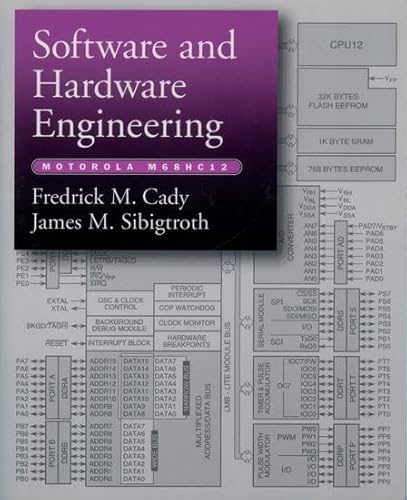
Software and Hardware Engineering: Motorola M68HC12
Ideal for use in microprocessor courses in engineering or computer science, Software and Hardware Engineering: Motorola M68HC12 provides an in-depth, hands-on introduction to the architecture and design of hardware and software for the Motorola M68HC12.
· Gives students the tools to use the Motorola M68HC12 in real-world applications
· Covers the hardware features of two versions of the M68HC12--the M68HC812A4 and the M68HC912B32
· Compares features common with the Motorola M68HC12's predecessor, the M68HC11
· Incorporates over 100 extensive programming examples
· Features chapters on fuzzy logic, programming a fuzzy inference engine, and the Background Debug Module
· Includes a detailed appendix covering the design of software for a debugging pod
This text can be used with its companion volume, Microcontrollers and Microcomputers: Principles of Software and Hardware Engineering (OUP, 1998), or with any other book that examines the general principles of microcomputer technology. It can also stand alone in a course devoted to the M68HC12. A world wide web site provides additional information including source files for all chapter examples: http://www.coe.montana.edu/ee/cady/books/m68hc12.htm.
Why Read This Book
You should read this book if you need a practical, example-rich introduction to the M68HC12 family and how to design both hardware and firmware around it. You will get detailed coverage of the M68HC12 architecture, programming in assembly/C, peripheral interfacing, and hands-on debugging using the Background Debug Module — plus an uncommon chapter showing how to implement fuzzy-logic routines on a microcontroller.
Who Will Benefit
Engineers or students who work with legacy Motorola/Freescale 68HC12 MCUs or who want a thorough case study in low-level microcontroller hardware/software co-design.
Level: Intermediate — Prerequisites: Basic digital logic and microcontroller concepts, familiarity with C and basic assembly language programming.
Key Takeaways
- Understand the M68HC12 core architecture, memory map, and interrupt model.
- Write and debug HC12 assembly and C code, using the Background Debug Module.
- Interface and control on-chip peripherals (timers, ADC, serial, I/O) in real-world examples.
- Design firmware that integrates hardware constraints and debugging strategies.
- Implement a simple fuzzy-logic inference engine and apply it in embedded contexts.
- Translate concepts and code patterns from the M68HC11 to the M68HC12 family.
Topics Covered
- Introduction to the M68HC12 Family and Development Environment
- M68HC12 Architecture and System Overview
- Instruction Set, Addressing Modes, and Assembly Language
- C Programming for the M68HC12 and Mixed-Language Development
- Memory Organization and Boot/Reset Behavior
- Interrupts, Exceptions, and Real-Time Considerations
- On-Chip Peripherals: Timers, ADC, Serial I/O, and Watchdog
- Hardware Interface Design and Peripheral Wiring
- Background Debug Module (BDM) and In-Circuit Debugging Techniques
- Software Engineering for Embedded Systems (design, testing, reliability)
- Fuzzy Logic and Implementing a Fuzzy Inference Engine
- Extensive Programming Examples and Case Studies
- Appendices: Development Tools, Debugging Tips, and Software Design Notes
Languages, Platforms & Tools
How It Compares
Covers much the same practical ground as HC11/HC12 university texts (e.g., common HC11/HC12 academic guides) but places greater emphasis on hands-on examples and BDM debug techniques and adds a distinctive chapter on fuzzy logic.