




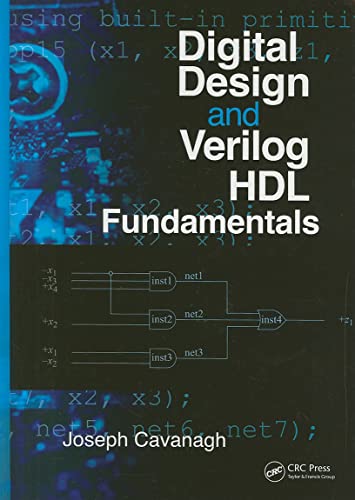
Digital Design and Verilog HDL Fundamentals
Comprehensive and self contained, this tutorial covers the design of a plethora of combinational and sequential logic circuits using conventional logic design and Verilog HDL. Number systems and number representations are presented along with various binary codes. Several advanced topics are covered, including functional decomposition and iterative networks. A variety of examples are provided for combinational and sequential logic, computer arithmetic, and advanced topics such as Hamming code error correction. Constructs supported by Verilog are described in detail. All designs are continued to completion. Each chapter includes numerous design issues of varying complexity to be resolved by the reader.
Why Read This Book
You will get a practical, example-driven introduction to digital logic and Verilog that takes designs from concept to completed RTL. The book emphasizes worked examples (arithmetic units, FSMs, Hamming codes) and Verilog constructs you can apply immediately when targeting FPGAs or building hardware interfaces.
Who Will Benefit
Early-career hardware engineers, firmware engineers moving into FPGA/RTL work, and students who need a practical bridge from digital logic theory to synthesizable Verilog.
Level: Beginner — Prerequisites: Basic algebra and familiarity with binary numbers/Boolean logic; prior programming experience is helpful but not required.
Key Takeaways
- Write synthesizable Verilog to express combinational and sequential logic
- Design and analyze finite state machines and sequential systems
- Implement fundamental computer arithmetic (adders, subtractors, simple multipliers) in RTL
- Apply number representations and binary coding schemes (including Hamming error correction)
- Decompose complex logic into modular, testable Verilog units and reason about synthesis issues
Topics Covered
- Introduction to Digital Design and Design Methodology
- Number Systems, Binary Codes, and Data Representation
- Boolean Algebra and Logic Simplification Techniques
- Combinational Logic Design: Gates, MUXes, Decoders, Encoders
- Arithmetic Circuits: Adders, Subtractors, Comparators
- Sequential Logic: Flip-Flops, Registers, Timing, and Setup/Hold
- Finite State Machines: Design and Implementation
- Verilog HDL Fundamentals: Syntax, Modules, and Data Types
- Modeling Combinational and Sequential Circuits in Verilog
- Synthesis Considerations and Simulation vs. Implementation
- Advanced Topics: Functional Decomposition and Iterative Networks
- Error Detection and Correction: Hamming Codes and Examples
- Design Examples Taken to Completion and Exercises
Languages, Platforms & Tools
How It Compares
More tutorial- and example-focused than Samir Palnitkar's 'Verilog HDL' and a more compact, applied alternative to Brown & Vranesic's textbooks; Cavanagh emphasizes step-by-step designs rather than exhaustive theory.