Understanding Yocto Project Layers: A Modular Approach to Embedded Systems Development
Dumb Embedded System Mistakes: Running The Wrong Code
Contents Introduction The Mistake Causes The Strategy Marking Embedded Linux Rootfs Overlay Files To Mark Marker Lines Script C/C++ Source Modifications Linux...
Getting Started with (Apache) NuttX RTOS - Part 1
NuttX RTOS is used in many products from companies like Sony, Xiaomi, Samsung, Google/Fitbit, WildernessLabs and many other companis. So, probably you are already using NuttX even without knowing it, like the you was using Linux on your TV, WiFi router more than 10 years ago and didn't know too! Today you will have the chance to discover a little bit of this fantastic Linux-like RTOS! Are you ready? So, let's get started!
VolksEEG: Rust Development On Adafruit nRF52840 Feather Express
Contents: Introduction Setup Hardware Workstation Software Checks USB Device Minicom JLinkExe FTHR840BOOT Contents OpenOCD VolksEEG/eeg-device-firmware PR "Merging initial implementation of the PC communications...
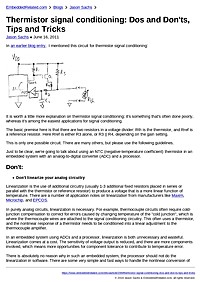
Thermistor signal conditioning: Dos and Don'ts, Tips and Tricks
In an earlier blog entry, I mentioned this circuit for thermistor signal conditioning: It is worth a little more explanation on thermistor signal conditioning; it's something that's often done poorly, whereas it's among the easiest...
Review: Embedded Software Design: A Practical Approach to Architecture, Processes, and Coding Techniques
Introduction Full disclosure: I was given a copy of this book to review. Embedded Software Design: A Practical Approach to Architecture, Processes, and Coding Techniques, by Jacob Beningo, is an excellent introduction to strategies for...

Small or fast?
Developers of software for desktop computers take code optimization for granted. Embedded developers typically need to pay much more attention to the details
Modern C++ in Embedded Development: (Don't Fear) The ++
While C is still the language of choice for embedded development, the adoption of C++ has grown steadily. Yet, reservations about dynamic memory allocation and fears of unnecessary code bloat have kept many in the C camp. This discourse aims to explore the intricacies of employing C++ in embedded systems, negotiating the issues of dynamic memory allocation, and exploiting the benefits of C++ offerings like std::array and constexpr. Moreover, it ventures into the details of the zero-overhead principle and the nuanced distinctions between C and C++. The takeaway? Armed with the right knowledge and a careful approach, C++ can indeed serve as a powerful, safer, and more efficient tool for embedded development.
Simple C++ State Machine Engine
When implementing state machines in your project it is an advantage to rely on a tried and tested state machine engine. This component is reused for every kind of application and helps the developer focus on the domain part of the software. In this article, the design process that turns a custom C++ code into a finite-state machine engine is fully described with motivations and tradeoffs for each iteration.
Getting Started With CUDA C on an Nvidia Jetson: Hello CUDA World!
In this blog post, I introduce CUDA, which is a framework designed to allow developers to take advantage of Nvidia's GPU hardware acceleration to efficiently implement certain type of applications. I demonstrate an implementation to perform vector addition using CUDA C and compare it against the traditional implementation in "regular" C.
Getting Started with the Microchip PIC® Microcontroller
This first post of a five part series looks at the available hardware options for getting started with Microchip 8-bit PIC® Microcontroller, explores the MPLAB® X Integrated Development Environment and walks through setting up a project to expose the configured clock to an external pin and implement a single output GPIO to light an LED.
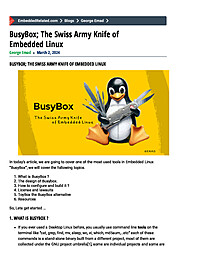
BusyBox; The Swiss Army Knife of Embedded Linux
In this article we cover the BusyBox, how it's designed to be optimized for embedded targets, and how to configure and build it in different ways, we also covered the license and limitation, which led to the development of ToyBox, I hope you enjoyed the article, please leave a comment for any correction or suggestions.
Creating a GPIO HAL and Driver in C
Creating a GPIO Hardware Abstraction Layer (HAL) in C allows for flexible microcontroller interfacing, overcoming the challenge of variability across silicon vendors. This method involves reviewing datasheets, identifying features, designing interfaces, and iterative development, as detailed in the "Reusable Firmware" process. A simplified approach prioritizes essential functions like initialization and read/write operations, showcased through a minimal interface example. The post also highlights the use of AI to expedite HAL generation. A detailed GPIO HAL version is provided, featuring extended capabilities and facilitating driver connection through direct assignments or wrappers. The significance of a configuration table for adaptable peripheral setup is emphasized. Ultimately, the blog illustrates the ease and scalability of developing a GPIO HAL and driver in C, promoting hardware-independent and extensible code for various interfaces, such as SPI, I2C, PWM, and timers, underscoring the abstraction benefits.
The RTOS minefield
Choosing an RTOS is challenging both technically and when assessing suppliers.
You Don't Need an RTOS (Part 1)
In this first article, we'll compare our two contenders, the superloop and the RTOS. We'll define a few terms that help us describe exactly what functions a scheduler does and why an RTOS can help make certain systems work that wouldn't with a superloop. By the end of this article, you'll be able to: - Measure or calculate the deadlines, periods, and worst-case execution times for each task in your system, - Determine, using either a response-time analysis or a utilization test, if that set of tasks is schedulable using either a superloop or an RTOS, and - Assign RTOS task priorities optimally.
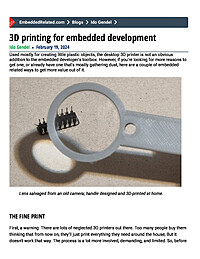
3D printing for embedded development
Used mostly for creating little plastic objects, the desktop 3D printer is not an obvious addition to the embedded developer's toolbox. However, if you're looking for more reasons to get one, or already have one that's mostly gathering dust, here are a couple of embedded-related ways to get more value out of it.
The volatile keyword
Although the C keyword volatile is very useful in embedded applications, care is needed to use it correctly and vigilance is required to ensure its correct implementation by compilers.
How to Implement Image Processing Algorithms in FPGA Hardware
Recognized for their parallelism and reconfigurability, FPGAs prove ideal for real-time processing in medical imaging and computer vision. The step-by-step approach starts with understanding FPGA basics, emphasizing their reconfigurable nature and parallel processing. It guides users in algorithm selection based on factors like processing speed, resource utilization, and adaptability, then highlights designing modular and scalable algorithms. The process includes simulation for verification, synthesis using tools like Xilinx Vivado and Intel Quartus Prime, interfacing with image sensors, and testing on real hardware. The conclusion underscores FPGA's advantages in image processing, presenting ongoing opportunities for innovation in diverse industries.
Getting Started With Zephyr: Writing Data to EEPROM
In this blog post, I show how to implement a Zephyr application to interact with EEPROM. I show how the Zephyr device driver model allows application writers to be free of the underlying implementation details. Unfortunately, the application didn't work as expected, and I'm still troubleshooting the cause.
What does it mean to be 'Turing complete'?
The term "Turing complete" describes all computers and even some things we don't expect to be as powerful as a typical computer. In this article, I describe what it means and discuss the implications of Turing completeness on projects that need just a little more power, on alternative processor designs, and even security.
Getting Started With Zephyr: Devicetree Overlays
In this blog post, I show how the Devicetree overlay is a valuable construct in The Zephyr Project RTOS. Overlays allow embedded software engineers to override the default pin configuration specified in Zephyr for a particular board. In this blog post, I use I2C as an example. Specifically, I showed the default I2C pins used for the nRF52840 development kit in the nominal Zephyr Devicetree. Then, I demonstrated how an overlay can be used to override this pin configuration and the final result.
C to C++: Using Abstract Interfaces to Create Hardware Abstraction Layers (HAL)
In C to C++, we've been exploring how to transition from a C developer to a C++ developer when working in embedded system. In this post, we will explore how to leverage classes to create hardware abstraction layers (HAL). You'll learn about the various inheritance mechanisms, what an virtual function is, and how to create an abstract class.

nRF5 to nRF Connect SDK migration via DFU over BLE
This writeup contains some notes on how I was able to migrate one of my clients projects based on the nRF5 SDK, to nRF Connect SDK (NCS) based firmware, via a DFU to devices in the field over BLE.

Assembly language is best - except when it isn’t
A look at why writing in C often produces more efficient code than hand-written assembly language.