







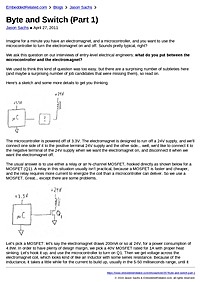
Byte and Switch (Part 1)
Imagine for a minute you have an electromagnet, and a microcontroller, and you want to use the microcontroller to turn the electromagnet on and off. Sounds pretty typical, right?We ask this question on our interviews of entry-level electrical...

Summary
Jason Sachs walks through the practical basics of using a microcontroller to switch an electromagnet. The blog explains both the electrical design (switching devices, protection, and power concerns) and the firmware/logic considerations needed to drive an inductive load reliably.
Key Takeaways
- Choose an appropriate switching device (BJT, MOSFET, or driver IC) based on current, voltage, and Rds(on)/SOA requirements.
- Calculate and implement proper flyback protection and snubber networks to protect the switch and MCU from inductive transients.
- Implement PWM and timing in firmware to control coil energization while respecting thermal and current limits.
- Protect the system with proper decoupling, transient suppression, and current-limiting strategies on the PCB.
- Test and validate the driver stage under realistic load and edge-case conditions to ensure reliability.
Who Should Read This
Early-career embedded hardware and firmware engineers, students, or interview candidates who want hands-on guidance for safely switching inductive loads with a microcontroller.
TimelessBeginner
Related Documents
- Consistent Overhead Byte Stuffing TimelessIntermediate
- PID Without a PhD TimelessIntermediate
- Introduction to Embedded Systems - A Cyber-Physical Systems Approach Still RelevantIntermediate
- Can an RTOS be really real-time? TimelessAdvanced
- Memory Mapped I/O in C TimelessIntermediate