







Book Review: "Turing's Cathedral"
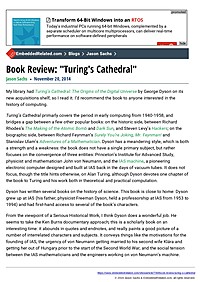
My library had Turing’s Cathedral: The Origins of the Digital Universe by George Dyson on its new acquisitions shelf, so I read it. I’d recommend the book to anyone interested in the history of computing. Turing’s Cathedral...

Summary
The author reviews George Dyson's Turing's Cathedral, summarizing its narrative of the origins of digital computing and the people and projects behind early machines. The review highlights how the historical account informs modern embedded and firmware practice by tracing design decisions, architecture choices, and collaborative dynamics that still shape systems engineering today.
Key Takeaways
- Recognize how early choices in computer architecture (von Neumann model, memory strategies) influence modern firmware and hardware constraints.
- Trace the interplay between mathematicians, physicists, and engineers to learn collaboration patterns useful in cross-disciplinary embedded projects.
- Apply historical design tradeoffs as lessons for resource-constrained development and low-level system design.
- Appreciate the origins of machine-level programming and tooling to better understand contemporary bare-metal and firmware development practices.
Who Should Read This
Embedded and firmware engineers (mid-level to senior) interested in the historical context that shaped modern computing architectures, tooling, and interdisciplinary engineering practices.
TimelessIntermediate
Related Documents
- Consistent Overhead Byte Stuffing TimelessIntermediate
- PID Without a PhD TimelessIntermediate
- Introduction to Embedded Systems - A Cyber-Physical Systems Approach Still RelevantIntermediate
- Can an RTOS be really real-time? TimelessAdvanced
- Memory Mapped I/O in C TimelessIntermediate