






Painting with Light to Measure Time
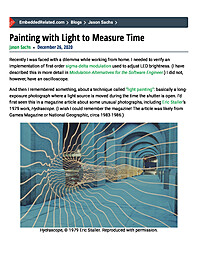
Recently I was faced with a dilemma while working from home. I needed to verify an implementation of first-order sigma-delta modulation used to adjust LED brightness. (I have described this in more detail in Modulation Alternatives for the...

Summary
Jason Sachs describes a practical, low-cost method to verify first-order sigma-delta modulation used for LED brightness control by "painting with light." The blog shows how to use long-exposure photography (or simple photodiodes) plus firmware tweaks to visualize pulse trains, measure timing, and detect modulation errors without an oscilloscope.
Key Takeaways
- Set up a long-exposure camera or simple photodiode rig to visualize LED pulse trains and persistence-of-vision effects.
- Capture and analyze sigma-delta modulation timing to quantify duty, jitter, and modulation accuracy.
- Modify microcontroller timer settings and firmware to correlate generated bitstreams with observed light patterns.
- Recognize and compensate for measurement artifacts (camera aliasing, exposure blur) and estimate measurement uncertainty.
Who Should Read This
Embedded firmware engineers and hardware-focused makers who need low-cost techniques to validate LED modulation, timing, and bitstream behavior without lab equipment.
Still RelevantIntermediate
Related Documents
- Consistent Overhead Byte Stuffing TimelessIntermediate
- PID Without a PhD TimelessIntermediate
- Introduction to Embedded Systems - A Cyber-Physical Systems Approach Still RelevantIntermediate
- Can an RTOS be really real-time? TimelessAdvanced
- Memory Mapped I/O in C TimelessIntermediate