






Complexity in Consumer Electronics Considered Harmful
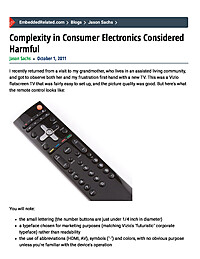
I recently returned from a visit to my grandmother, who lives in an assisted living community, and got to observe both her and my frustration first-hand with a new TV. This was a Vizio flatscreen TV that was fairly easy to set up, and the picture...

Summary
Jason Sachs reflects on a firsthand experience with a Vizio TV to argue that increasing feature complexity in consumer electronics harms usability and maintenance. The piece explains how feature creep and poor product design create user frustration and higher support costs, and it outlines practical implications for embedded and firmware engineers.
Key Takeaways
- Prioritize essential features and simple, discoverable user interfaces for consumer devices.
- Limit feature creep by enforcing scope, clear requirements, and pragmatic trade-offs in firmware design.
- Design for real users: include sensible defaults, accessible controls, and straightforward recovery paths.
- Test products with representative users and environments to surface usability and maintenance issues early.
Who Should Read This
Intermediate embedded and firmware engineers, product managers, and designers working on consumer IoT or embedded Linux devices who need to balance features, usability, and long-term maintenance.
Still RelevantIntermediate
Related Documents
- Consistent Overhead Byte Stuffing TimelessIntermediate
- PID Without a PhD TimelessIntermediate
- Introduction to Embedded Systems - A Cyber-Physical Systems Approach Still RelevantIntermediate
- Can an RTOS be really real-time? TimelessAdvanced
- Memory Mapped I/O in C TimelessIntermediate