







Mutex vs. Semaphores – Part 2: The Mutex & Mutual Exclusion Problems
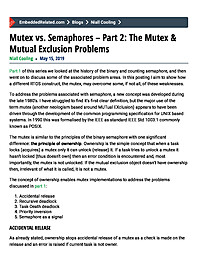
Part 1 of this series we looked at the history of the binary and counting semaphore, and then went on to discuss some of the associated problem areas. In this posting I aim to show how a different RTOS construct, the mutex, may overcome some, if...

Summary
This blog post explains how mutexes differ from semaphores and how mutexes address common mutual-exclusion problems in RTOS-based systems. Readers will learn mutex ownership, priority inversion and inheritance, and practical patterns to use mutexes safely in embedded firmware.
Key Takeaways
- Differentiate between mutexes and binary/counting semaphores and when to use each
- Recognize mutual-exclusion issues such as race conditions, deadlock, and priority inversion
- Apply mutex features like ownership, recursive locking, and priority inheritance to mitigate problems
- Design locking patterns for RTOS-based embedded systems to avoid deadlocks and timing faults
Who Should Read This
Intermediate embedded firmware developers and RTOS engineers working on microcontroller-based systems who want to improve concurrency correctness and real-time behavior.
TimelessIntermediate
Related Documents
- Consistent Overhead Byte Stuffing TimelessIntermediate
- PID Without a PhD TimelessIntermediate
- Introduction to Embedded Systems - A Cyber-Physical Systems Approach Still RelevantIntermediate
- Can an RTOS be really real-time? TimelessAdvanced
- Memory Mapped I/O in C TimelessIntermediate