Summary
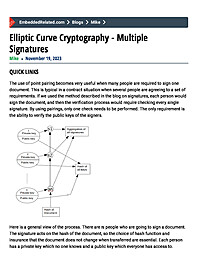
This blog by Mike explains how elliptic curve cryptography (ECC) can be extended to support multiple-signature schemes tailored for embedded systems. It covers protocol variants, implementation considerations on constrained devices, and security trade-offs relevant to IoT and firmware signing.
Key Takeaways
- Explain the difference between single-signature ECC (e.g., ECDSA) and multisignature/threshold ECC schemes (e.g., Schnorr/MuSig).
- Compare security and performance trade-offs for multisig approaches on constrained MCUs and embedded Linux platforms.
- Describe practical key management, nonce handling, and anti-replay measures required for safe multisignature implementations.
- Implement basic multisignature flows and integration points for secure firmware signing, OTA, and multi-party authorization.
- Evaluate hardware acceleration and secure element usage to reduce latency and increase side-channel resistance for ECC multisigs.
Who Should Read This
Advanced embedded firmware or security engineers working on IoT devices, secure boot, or firmware updates who need to implement or assess ECC multisignature schemes for multi-party authorization or distributed signing.
Still RelevantAdvanced
Related Documents
- Consistent Overhead Byte Stuffing TimelessIntermediate
- PID Without a PhD TimelessIntermediate
- Introduction to Embedded Systems - A Cyber-Physical Systems Approach Still RelevantIntermediate
- Can an RTOS be really real-time? TimelessAdvanced
- Memory Mapped I/O in C TimelessIntermediate