






3D printing for embedded development
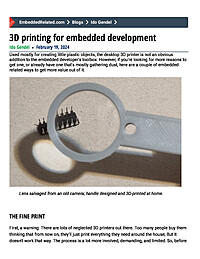
Used mostly for creating little plastic objects, the desktop 3D printer is not an obvious addition to the embedded developer's toolbox. However, if you're looking for more reasons to get one, or already have one that's mostly gathering dust, here are a couple of embedded-related ways to get more value out of it.

Summary
Ido Gendel explains how desktop 3D printers can become practical tools for embedded developers beyond simple prototypes. The article shows how to use 3D printing for enclosures, test fixtures, sensor housings, cable management, and rapid mechanical-hardware iterations, plus material and design tips relevant to embedded workflows.
Key Takeaways
- Design enclosures with integrated standoffs, ventilation, and heat-set inserts to speed assembly and improve durability.
- Build printed test fixtures and pogo‑pin jigs to streamline in-circuit programming, boundary tests, and burn‑in procedures.
- Select appropriate print materials (PLA, PETG, ABS, TPU) and print orientations to match thermal, environmental, and RF requirements.
- Iterate mechanical-hardware co-design early to reduce PCB redesign cycles and accelerate firmware bring-up.
- Create custom sensor housings, cable strain reliefs, and antenna mounts to improve reliability and repeatability in IoT deployments.
Who Should Read This
Embedded and firmware engineers (and advanced hobbyists) who want to reduce prototyping time, improve test coverage, and integrate mechanical design into embedded workflows.
Still RelevantIntermediate
Related Documents
- Consistent Overhead Byte Stuffing TimelessIntermediate
- PID Without a PhD TimelessIntermediate
- Introduction to Embedded Systems - A Cyber-Physical Systems Approach Still RelevantIntermediate
- Can an RTOS be really real-time? TimelessAdvanced
- Memory Mapped I/O in C TimelessIntermediate