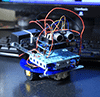








Arduino robotics #4 - HC-SR04 ultrasonic sensor
Arduino RoboticsArduino robotics is a series of article chronicling my first autonomous robot build, Clusterbot. This build is meant to be affordable, relatively easy and instructive. The total cost of the build is around $50.
1. Arduino robotics - motor control2. Arduino robotics - chassis, locomotion and power3. Arduino robotics - wiring, coding and a test run4.Arduino robotics #3 - wiring, coding and a test run
Arduino RoboticsArduino robotics is a series of article chronicling my first autonomous robot build, Clusterbot. This build is meant to be affordable, relatively easy and instructive. The total cost of the build is around $50.
1. Arduino robotics - motor control2. Arduino robotics - chassis, locomotion and power3. Arduino robotics - wiring, coding and a test run4.Arduino robotics #2 - chassis, locomotion and power
Arduino RoboticsBeginner robotics is a series of article chronicling my first autonomous robot build, Clusterbot. This build is meant to be affordable, relatively easy and instructive. The total cost of the build is around $50.
1. Arduino robotics - motor control2. Arduino robotics - chassis, locomotion and power3. Arduino robotics - wiring, coding and a test run4.Introduction to Microcontrollers - More Timers and Displays
Building Your World Around TimersBy now you have seen four different ways to use timers in your programs. Next we will look at some ways to produce the effect of multiple parallel streams of work in your program with the help of timers. This effect is only an appearance, not a reality, since a single microcontroller (one core) can only run a single thread of code. However, since microcontrollers are so fast in relation to a great many of the tasks to...
Arduino robotics #1 - motor control
Arduino RoboticsBeginner robotics is a series of article chronicling my first autonomous robot build, Clusterbot. This build is meant to be affordable, relatively easy and instructive. The total cost of the build is around $50.
1. Arduino robotics - motor control2. Arduino robotics - chassis, locomotion and power3. Arduino robotics - wiring, coding and a test run4.Introduction to Microcontrollers - Adding Some Real-World Hardware
When 2 LEDs Just Don't Cut It AnymoreSo far, we've done everything in this series using two LEDs and one button. I'm guessing that the thrill of blinking an LED has worn off by now, hard as that is to imagine. What's more, we've just about reached the limits of what we can learn with such limited I/O. We have come to the point where we need to add some hardware to our setup to continue with additional concepts and microcontroller...
Introduction to Microcontrollers - Timers
Timers - Because "When" MattersComputer programs are odd things, for one reason because they have no concept of time. They may have the concept of sequential execution, but the time between instructions can be essentially any number and the program won't notice or care (unless assumptions about time have been built into the program by the programmer). But the real world is not like this. In the real world, especially the real embedded world,...
Introduction to Microcontrollers - More On Interrupts
A Little More Detail About The Interrupt MechanismIt's time to look a little closer at what happens in an interrupt request and response. Again this is in general terms, and different microcontroller designs may do things somewhat differently, but the basics remain the same. Most but not all interrupt requests are latched, which means the interrupt event sets a flag that stays set even if the interrupt event then goes away. It is this latched flag...
Introduction to Microcontrollers - Interrupts
It's Too Soon To Talk About Interrupts!That, at least, could be one reaction to this chapter. But over the years I've become convinced that new microcontroller programmers should understand interrupts before being introduced to any complex peripherals such as timers, UARTs, ADCs, and all the other powerful function blocks found on a modern microcontroller. Since these peripherals are commonly used with interrupts, any introduction to them that does not...
Introduction to Microcontrollers - More On GPIO
Now that we have our LED Blinky program nailed down, it's time to look more closely at outputs, add button/switch inputs, and work with reading inputs and driving outputs based on those inputs.
It's ON - No, It's OFF - No, It's ON...I have to confess, I cheated. Well, let's say I glossed over something very important. In our LED Blinky program, we never cared about whether an output '1' or an output '0' turned on the LED. Since we were just...
Embedded Systems - free EdX course by UT-Austin!
I was very excited to see that there will be an Embedded Systems class available for free at https://www.edx.org/course/utaustin/ut-6-01x/embedded-systems-shape-world/1172
It's free to sign up and take the online class at the EdX website.
More exciting is that the class is based on a TI Launchpad Tiva microcontroller development board. The Tiva Launchpad features an 80-MHz ARM Cortex M-4 MCU with 256 KB of flash storage, 32 KB of RAM and 43 general purpose I/O pins.
Arduino robotics #2 - chassis, locomotion and power
Arduino RoboticsBeginner robotics is a series of article chronicling my first autonomous robot build, Clusterbot. This build is meant to be affordable, relatively easy and instructive. The total cost of the build is around $50.
1. Arduino robotics - motor control2. Arduino robotics - chassis, locomotion and power3. Arduino robotics - wiring, coding and a test run4.OOKLONE: a cheap RF 433.92MHz OOK frame cloner
IntroductionA few weeks ago, I bought a set of cheap wireless outlets and reimplemented the protocol for further inclusion in a domotics platform. I wrote a post about it here:
//www.embeddedrelated.com/showarticle/620.php
Following that, I had access to another outlet from a different vendor:
http://www.castorama.fr/store/Prise-telecommandee-BLYSS---Interieur-prod4470027.html
The device documentation mentions that it operates on the same frequency as the previous...
Trust, but Verify: Examining the Output of an Embedded Compiler
I work with motor control firmware on the Microchip dsPIC33 series of microcontrollers. The vast majority of that firmware is written in C, with only a few percent in assembly. And I got to thinking recently: I programmed in C and C++ on an Intel PC from roughly 1991 to 2009. But I don’t remember ever working with x86 assembly code. Not once. Not even reading it. Which seems odd. I do that all the time with embedded firmware. And I think you should too. Before I say why, here are...
Arduino robotics #3 - wiring, coding and a test run
Arduino RoboticsArduino robotics is a series of article chronicling my first autonomous robot build, Clusterbot. This build is meant to be affordable, relatively easy and instructive. The total cost of the build is around $50.
1. Arduino robotics - motor control2. Arduino robotics - chassis, locomotion and power3. Arduino robotics - wiring, coding and a test run4.Introduction to Deep Insight Analysis for RTOS Based Applications
Over the past several years, embedded systems have become extremely complex. As systems become more complex, they become harder and more time consuming to debug. It isn’t uncommon for development teams to spend more than 40% development cycle time just debugging their systems. This is where deep insight analysis has the potential to dramatically decrease costs and time to market.
Defining Deep Insight Analysis
Deep insight analysis is a set of tools and techniques that can be...
Mounting plate for Arduino
While having a breadboard with your microcontroller is necessary, it is very cumbersome if the two aren't fastened together somehow. You can buy mounting plates, but I choose to make one.
Improving the Reload2 active load
IntroductionWith another colleague at work, we are currently developing an electronic board that will eventually be powered over Ethernet. To gain more experience with this technology, we prototyped a standalone power supply stage.
We want to test this stage with different load profiles. While we already have professional grade active loads at work, I had previously read about the Reload2 product from Arachnidlabs, a low cost active load sold on Hackaday:
3 Overlooked Embedded Software Elements
Have you ever wondered, while you and your team are busy writing software if the foundation of how embedded software systems are built has changed and left you in the dust? What if while you were busily focusing on getting your product out the door, fighting bugs, and dealing with supply issues, there were techniques and processes that you completely overlooked that could save the day? I’ve found three elements embedded software teams often underutilize that could dramatically improve...
Make Your Own MCU Boards (2023 Teardown Conference)
Ditch the development boards! Products like the Nucleo development boards serve a wonderful purpose, but they’re ill-suited for projects that need to be small and cheap, such as hobby projects or products just beginning a production run. In this talk (a recording from the 2023 Teardown Conference), you’ll learn how to put a microcontroller or other custom circuit on a PCB a little larger than a stick of gum for less than $3 a board.
Getting Started with (Apache) NuttX RTOS Part 2 - Looking Inside and Creating Your Customized Image
In the previous article (https://www.embeddedrelated.com/showarticle/1524.p...) we saw how to run NuttX RTOS using the SIMulator. Today we will see how NuttX's directory tree is organized and how to use the menuconfig to enable some applications, including some tricks to search and solve dependencies.
NuttX Directories organization:
If you have previously compiled the Linux kernel or the U-Boot bootloader you will see that the NuttX source tree organization is...
3 Overlooked Embedded Software Elements
Have you ever wondered, while you and your team are busy writing software if the foundation of how embedded software systems are built has changed and left you in the dust? What if while you were busily focusing on getting your product out the door, fighting bugs, and dealing with supply issues, there were techniques and processes that you completely overlooked that could save the day? I’ve found three elements embedded software teams often underutilize that could dramatically improve...
Why Containers Are the Cheat Code for Embedded DevOps
Embedded software teams have long accepted toolchain setup as “part of the job,” but it’s a hidden productivity killer. Manual installs waste days, slow onboarding, and derail CI pipelines with “works on my machine” issues. While enterprise software solved this years ago with containerization, many embedded teams are still stuck replicating fragile environments. Containers offer a proven fix: a portable, reproducible build environment that works identically on laptops and CI servers. No brittle scripts, mismatched versions, or wasted time—just code that builds. IAR has gone further by delivering pre-built, performance-tuned Docker images for Arm, RISC-V, and Renesas architectures, ready for GitHub Actions and CI/CD pipelines. For regulated industries, containers simplify audits and compliance by enabling validation once and reuse everywhere. The result: faster onboarding, consistent builds, and stronger safety assurance. Containers aren’t a luxury—they’re the cheat code embedded teams need to modernize DevOps and compete effectively.
AI at the Edge - Can I run a neural network in a resource-constrained device?
Hello Related Communities,
This is my first time blogging since joining Stephane in November. He and I were at Embedded World together and he asked me to write about some of the important trends as they relate to all of you. I expect to post others in the near future, but the biggest trend in the embedded space was all of the activity around artificial intelligence (AI) at the edge.
This trend caught me a bit by surprise. I have been doing a lot of reading about AI over the last...
Getting Started with the Microchip PIC® Microcontroller
This first post of a five part series looks at the available hardware options for getting started with Microchip 8-bit PIC® Microcontroller, explores the MPLAB® X Integrated Development Environment and walks through setting up a project to expose the configured clock to an external pin and implement a single output GPIO to light an LED.
Working with Microchip PIC 8-bit Interrupts
This fifth and final post of the Getting Started with Microchip PIC 8 Bit Development series looks at interrupts on 8-bit PIC microcontrollers. After a review of basic interrupt functionality, an actual implementation is explored with the development of a four bit counter driven via Timer0 interrupts whose value is displayed through four LEDs on Microchip's Curiosity HPC Development Board.
Breaking AES with an Oscilloscope
AES is a powerful encryption algorithm that protects some our most important secrets. But did you know that many devices are inadvertently leaking the value of their private key through their power pins?! Join me in this special preview of my upcoming workshop at the Embedded Systems Summit (14-16 October 2025 in San Jose, CA) as we explore the world of hardware security and discover just how easy it could be to break AES encryption with only an oscilloscope and some math.
Make Your Own MCU Boards (2023 Teardown Conference)
Ditch the development boards! Products like the Nucleo development boards serve a wonderful purpose, but they’re ill-suited for projects that need to be small and cheap, such as hobby projects or products just beginning a production run. In this talk (a recording from the 2023 Teardown Conference), you’ll learn how to put a microcontroller or other custom circuit on a PCB a little larger than a stick of gum for less than $3 a board.
STM32 B-CAMS-OMV Walkthrough
The STM32 B-CAMS-OMV camera module offers an accessible way to get started with embedded vision. Coupled with the STM32H747I-DISCO discovery kit and the FP-AI-VISION1 function pack, it's possible to be up and running in minutes.
This video describes the camera connection interface to the discovery kit and the key software functions required to control the camera and process its data. We review the ISP (Image Signal Processor) interface with examples of image processing...
Mounting plate for Arduino
While having a breadboard with your microcontroller is necessary, it is very cumbersome if the two aren't fastened together somehow. You can buy mounting plates, but I choose to make one.