






Arduino robotics #4 - HC-SR04 ultrasonic sensor
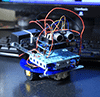
Lonnie Honeycutt shows how to turn a $50 mobile platform into a simple autonomous robot by adding an HC-SR04 ultrasonic sensor to an Arduino. The post walks through wiring, a minimal test sketch and the integration code used on Clusterbot, plus practical tips on range limits, motor choices and library options to make obstacle avoidance reliable for hobby builds.
Arduino robotics #3 - wiring, coding and a test run
Lonnie Honeycutt walks through wiring, coding, and the first test run of Clusterbot, a budget Arduino robot build costing about $50. The post provides a clear pin-mapping to the TB6612FNG motor driver, ready-to-upload Arduino movement functions, and practical tips like tinning thin battery wires. You also get PWM calibration values and the measured RPM timing the author used to make reliable turns.
Arduino robotics #2 - chassis, locomotion and power
Lonnie Honeycutt walks through building Clusterbot's round differential-drive chassis, showing how a circular base and Tamiya gearbox simplify turning and torque tradeoffs. The post covers motor selection, wheel fit, balance issues, and a practical two-battery power arrangement with VMOT for the motors and a separate 9V for the Arduino. Expect hands-on tips and lessons learned from a first-time robot build.
Introduction to Microcontrollers - More Timers and Displays
Mike Silva walks through using a single hardware timer to create the illusion of parallel tasks, combining a millisecond tick, deadline checks, and a cyclic executive to run time-driven and event-driven work. He shows safe deadline code that handles timer rollover and ISR races, and provides practical STM32 examples including SysTick-driven delays, atomic GPIO BSRR writes for LCD control, and a button-driven display demo.
Arduino robotics #1 - motor control
Clusterbot is Lonnie Honeycutt's first autonomous robot, built on a tight budget to teach practical motor control. This post explains why you cannot drive motors directly from an Arduino, how to wire and enable the Toshiba TB6612FNG motor driver, and offers hands-on PWM and calibration tips for getting smooth motion from cheap Mabuchi FA-130 toy motors.
Introduction to Microcontrollers - Adding Some Real-World Hardware
Two blinking LEDs only teach you so much, so Mike designed a docking board that adds a 4x20 HD44780 LCD, a 4x4 button matrix, four LEDs, DIP switches and an ADC potentiometer for AVR and STM32 experiments. This post shows how to wire and drive the HD44780 in 4-bit mode, calibrate microsecond and millisecond software delays, use the busy flag to speed writes, and includes AVR example code to get the display running.
Introduction to Microcontrollers - Timers
Time is everything in embedded systems, and Mike Silva walks through how microcontroller timers turn clock pulses into dependable events. He covers prescalers, counter bit widths, overflow versus compare modes, atomic multi-byte register access, the "-1 rule", input capture and compare leapfrogging, with concrete AVR and STM32 code that highlights common pitfalls and reliable patterns for precise ticks.
Introduction to Microcontrollers - More On Interrupts
Interrupts are powerful but dangerous, and Mike Silva breaks down how they actually behave on microcontrollers and why they can corrupt data. This post explains latched flags, pending and priority behavior, ISR nesting, and common read-modify-write hazards, then shows practical fixes like targeted interrupt masking and using atomic GPIO hardware so you can stop chasing sporadic bugs.
Introduction to Microcontrollers - Interrupts
Interrupts are not magic, they are the practical tool that lets a microcontroller respond in microseconds while still doing background work. This introduction explains what an interrupt and an ISR are, how return addresses and CPU state are saved, and why ISRs must be short and carefully written. AVR and STM32 external-interrupt examples show real configuration steps and key gotchas to watch for.
Introduction to Microcontrollers - More On GPIO
Polarity matters: an output '1' does not always mean an LED lights, and inputs are just as picky. This post walks through LED driving basics, pull resistors for buttons, and practical bitwise techniques to read and write individual GPIO pins on AVR and STM32 boards. It also explains why polling rates and mechanical bounce make button handling trickier than it looks and what to watch for next.
STM32 VS Code Extension Under The Hood
ST's STM32 VS Code extension hides useful CMake projects and VS Code tasks behind a friendly UI, but understanding what it generates lets you bend it to your needs. This video peels back the layers to show the generated CMake files, how to modify them, how to add a VS Code-invokable flash task, and how to enable C++ support alongside C. The STM32 F0 example and flash task are available on GitHub.
Choosing a Microcontroller for Your Vehicle
Picking the right microcontroller can make or break an autonomous vehicle project, and this post gives a practical checklist to help. It walks through voltage and power needs, memory and IO planning, cost and availability tradeoffs, and when to step up from an 8-bit MCU to a 32-bit controller or single-board computer. Real-world board examples illustrate the choices.
Introduction to Microcontrollers - Adding Some Real-World Hardware
Two blinking LEDs only teach you so much, so Mike designed a docking board that adds a 4x20 HD44780 LCD, a 4x4 button matrix, four LEDs, DIP switches and an ADC potentiometer for AVR and STM32 experiments. This post shows how to wire and drive the HD44780 in 4-bit mode, calibrate microsecond and millisecond software delays, use the busy flag to speed writes, and includes AVR example code to get the display running.
Arduino robotics #3 - wiring, coding and a test run
Lonnie Honeycutt walks through wiring, coding, and the first test run of Clusterbot, a budget Arduino robot build costing about $50. The post provides a clear pin-mapping to the TB6612FNG motor driver, ready-to-upload Arduino movement functions, and practical tips like tinning thin battery wires. You also get PWM calibration values and the measured RPM timing the author used to make reliable turns.
A wireless door monitor based on the BANO framework
Fabien Le Mentec built a battery-powered wireless door monitor and a reusable node framework called BANO to monitor doors across seven floors without wired links. The post highlights BANO's 17-byte key,value protocol, the node runtime that enables wake-on-interrupt low-power operation, and practical RF choices like the NRF905 plus a 330 µF cap to handle coin-cell transmission peaks. It includes source, PCB, and base station notes.
Mounting plate for Arduino
While having a breadboard with your microcontroller is necessary, it is very cumbersome if the two aren't fastened together somehow. You can buy mounting plates, but I choose to make one.
Intro to Microcontrollers Part 2: AVR Microcontrollers
This follow-up explores getting an AVR Dragon working with an ATtiny24A, covering the necessary cables, BOM choices, and Atmel Studio setup. It walks through firmware updates, an ADC-based internal temperature sensor example using reduced-noise ADC and ISR handling, and practical debugging tips including debugWire versus ISP and high-voltage recovery. Expect candid hardware caveats like weak drive strength and 5V power quirks.
3 Overlooked Embedded Software Elements
Jacob Beningo points out three often-overlooked elements that can make embedded projects less painful and faster to ship. He highlights model-generated code for off-target iteration, configuration-generated code to manage SKUs and avoid fragile conditional compilation, and automated test harnesses to catch regressions early. The post gives practical reasons to consider each approach and how they fit into modern embedded DevOps.
Introduction to Deep Insight Analysis for RTOS Based Applications
Debugging can consume over 40% of a development cycle, and Jacob Beningo argues RTOS projects need more than breakpoints and assertions. He presents deep insight analysis as a trio of techniques—RTOS-aware debugging, run-time analysis, and profiling with coverage—that expose what the system is actually doing. These methods help engineers cut guesswork and speed verification of complex embedded applications.
AI at the Edge - Can I run a neural network in a resource-constrained device?
AI at the edge is no longer science fiction, it can run on tiny, resource-constrained devices like Arm Cortex-M4 and M7 microcontrollers. This post introduces inference-only neural networks on MCUs, explains why edge AI matters for power, latency, and privacy, and points to practical toolchains such as STM32Cube.AI, Arm NN, and AWS Greengrass to get started quickly.
Introduction to Deep Insight Analysis for RTOS Based Applications
Debugging can consume over 40% of a development cycle, and Jacob Beningo argues RTOS projects need more than breakpoints and assertions. He presents deep insight analysis as a trio of techniques—RTOS-aware debugging, run-time analysis, and profiling with coverage—that expose what the system is actually doing. These methods help engineers cut guesswork and speed verification of complex embedded applications.
Why Containers Are the Cheat Code for Embedded DevOps
Embedded software teams have long accepted toolchain setup as “part of the job,” but it’s a hidden productivity killer. Manual installs waste days, slow onboarding, and derail CI pipelines with “works on my machine” issues. While enterprise software solved this years ago with containerization, many embedded teams are still stuck replicating fragile environments. Containers offer a proven fix: a portable, reproducible build environment that works identically on laptops and CI servers. No brittle scripts, mismatched versions, or wasted time—just code that builds. IAR has gone further by delivering pre-built, performance-tuned Docker images for Arm, RISC-V, and Renesas architectures, ready for GitHub Actions and CI/CD pipelines. For regulated industries, containers simplify audits and compliance by enabling validation once and reuse everywhere. The result: faster onboarding, consistent builds, and stronger safety assurance. Containers aren’t a luxury—they’re the cheat code embedded teams need to modernize DevOps and compete effectively.
3 Overlooked Embedded Software Elements
Jacob Beningo points out three often-overlooked elements that can make embedded projects less painful and faster to ship. He highlights model-generated code for off-target iteration, configuration-generated code to manage SKUs and avoid fragile conditional compilation, and automated test harnesses to catch regressions early. The post gives practical reasons to consider each approach and how they fit into modern embedded DevOps.
Working with Microchip PIC 8-bit Interrupts
This fifth and final post of the Getting Started with Microchip PIC 8 Bit Development series looks at interrupts on 8-bit PIC microcontrollers. After a review of basic interrupt functionality, an actual implementation is explored with the development of a four bit counter driven via Timer0 interrupts whose value is displayed through four LEDs on Microchip's Curiosity HPC Development Board.
Getting Started with the Microchip PIC® Microcontroller
This first post of a five part series looks at the available hardware options for getting started with Microchip 8-bit PIC® Microcontroller, explores the MPLAB® X Integrated Development Environment and walks through setting up a project to expose the configured clock to an external pin and implement a single output GPIO to light an LED.
AI at the Edge - Can I run a neural network in a resource-constrained device?
AI at the edge is no longer science fiction, it can run on tiny, resource-constrained devices like Arm Cortex-M4 and M7 microcontrollers. This post introduces inference-only neural networks on MCUs, explains why edge AI matters for power, latency, and privacy, and points to practical toolchains such as STM32Cube.AI, Arm NN, and AWS Greengrass to get started quickly.
Breaking AES with an Oscilloscope
AES is a powerful encryption algorithm that protects some our most important secrets. But did you know that many devices are inadvertently leaking the value of their private key through their power pins?! Join me in this special preview of my upcoming workshop at the Embedded Systems Summit (14-16 October 2025 in San Jose, CA) as we explore the world of hardware security and discover just how easy it could be to break AES encryption with only an oscilloscope and some math.
STM32 B-CAMS-OMV Walkthrough
Want to prototype embedded vision quickly? This walkthrough shows how the STM32 B-CAMS-OMV camera module pairs with the STM32H747I-DISCO discovery kit and the FP-AI-VISION1 function pack to get you running in minutes. The video covers the camera connection interface, key software functions to control and process data, and the ISP features that let image processing run inside the camera. The STM32 H7 project with B-CAMS-OMV drivers is available on GitHub.
Make Your Own MCU Boards (2023 Teardown Conference)
Ditch the development boards! Products like the Nucleo development boards serve a wonderful purpose, but they’re ill-suited for projects that need to be small and cheap, such as hobby projects or products just beginning a production run. In this talk (a recording from the 2023 Teardown Conference), you’ll learn how to put a microcontroller or other custom circuit on a PCB a little larger than a stick of gum for less than $3 a board.
Mounting plate for Arduino
While having a breadboard with your microcontroller is necessary, it is very cumbersome if the two aren't fastened together somehow. You can buy mounting plates, but I choose to make one.