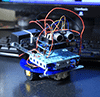








My little runaway...

Since most vehicles won't float and land gently from more than a few inches, some type of stand is needed to keep the vehicle stationary as work is being done. It can also prevent crashes and broken things, which becomes more important as the vehicle becomes larger and heavier.
For now, most of my work is done with 1/10 scale or smaller vehicles, so I made a stand from leftover wood. Full-size vehicles may require a hydraulic lift and jack stands.
Smaller vehicles can be held by...
The Other Kind of Bypass Capacitor

There’s a type of bypass capacitor I’d like to talk about today.
It’s not the usual power supply bypass capacitor, aka decoupling capacitor, which is used to provide local charge storage to an integrated circuit, so that the high-frequency supply currents to the IC can bypass (hence the name) all the series resistance and inductance from the power supply. This reduces the noise on a DC voltage supply. I’ve...
It ain't heavy, it's my robot...
Unmanned Ground Vehicles - Design considerations for man-portable/packable vehicles
A UGV is “a ground based mechanical device that can sense and interact with its environment.” (Carlson, How)
A Field Robot is expected to work outdoors, though generally not in rain or snow, including rough terrain, dirt and dust. (Carlson, Reliability)
A Man-portable robot weighs less than 40 pounds, or is capable of being broken down into subassemblies for two soldiers weighing less than 40...
Unmanned Ground Vehicles - Design Considerations for Snow and Cold Environments
It's that time of year when the white stuff falls from the sky across the US, and with it comes lower temperatures. These conditions must be taken into consideration when designing a vehicle for outdoor use.
A few definitions from wikipedia:
Flurry: light, brief snowfall
Snow shower: intermittent snowfall
Light snow: over 1km visibility
Moderate snow: 0.5 to 1km visibility
Heavy snow: less than 0.5km visibility
Blizzard: lasts 3 hours or longer, sustained wind to 35mph, visibility...
Vala applications on Embedded Linux: maybe a clever choice [part 1]

Vala is a sexy, open source, high level programming language that appeared in 2006, it counts with a modern typing system, is object oriented, compiled and statically typed, it has a almost identical syntax to C# and is maintained by GNOME. The language was created as a power abstraction of the GLib and GTK libraries, two considerably lightweight and powerful libraries written in C, and it is used in projects such as GNOME Clocks, Shotwell, GXml and Elementary OS.
namespace...How to Succeed in Motor Control: Olaus Magnus, Donald Rumsfeld, and YouTube
Almost four years ago, I had this insight — we were doing it wrong! Most of the application notes on motor control were about the core algorithms: various six-step or field-oriented control methods, with Park and Clarke transforms, sensorless estimators, and whatnot. It was kind of like a driving school would be, if they taught you how the accelerator and brake pedal worked, and how the four-stroke Otto cycle works in internal combustion engines, and handed you a written...
Round Round Get Around: Why Fixed-Point Right-Shifts Are Just Fine
Today’s topic is rounding in embedded systems, or more specifically, why you don’t need to worry about it in many cases.
One of the issues faced in computer arithmetic is that exact arithmetic requires an ever-increasing bit length to avoid overflow. Adding or subtracting two 16-bit integers produces a 17-bit result; multiplying two 16-bit integers produces a 32-bit result. In fixed-point arithmetic we typically multiply and shift right; for example, if we wanted to multiply some...
Favorite Tools: C++11 User-defined literals

In many software domains units of measurement are frequently critical to the software's data processing requirements. Those same units, or rather the use of the wrong units, are often the source of bugs and disastrous mistakes. Although useful for other purposes, user-defined literals are an excellent addition to the C++11 standard and handy when working with units of measurement.
Suppose a device measures velocity. To help prevent errors, the software specification requires...
Surprising Linux Real Time Scheduler Behavior
I have recently been helping with embedded software design and development for a data acquisition and visualization device. The software executes within an embedded Linux context and consists of various animated user interfaces rendering the acquired data.
The data is received via a UART and a SPI connection. During project development we noticed poor UART data latency issues during heavy user interface animations. For this product to properly meet its acquisition requirements, the UART...
Favorite Tools - Look Up Tables
As we grow in our engineering careers, we must continually add new tools to our collective tool kits. One favorite tool in my toolkit will be obvious to many experienced embedded software engineers. I still remember learning this approach early in my career via code written by colleague David Starling. The tool in question:
Look up tablesLook up tables simplify code and improve firmware maintenance. What is a look up table? A look up table is often nothing more complex than a...
Live Streaming from Embedded World!

For those of you who won't be attending Embedded World this year, I will try to be your eyes and ears by video streaming live from the show floor.
I am not talking improvised streaming from a phone, but real, high quality HD streaming with a high-end camera and a device that will bond three internet connections (one wifi and two cellular) to ensure a steady, and hopefully reliable, stream. All this to hopefully give those of you who cannot be there in person a virtual...
Optimizing Optoisolators, and Other Stories of Making Do With Less
It’s been a few months since I’ve rolled up my sleeves here and dug into some good old circuit design issues. I started out with circuit design articles, and I’ve missed it.
Today’s topic will be showing you some tricks for how to get more performance out of an optoisolator. These devices — and I’m tempted to be lazy and call them “optos”, but that sounds more like a cereal with Greek yogurt-covered raisins — are essentially just an LED...
An Iterative Approach to USART HAL Design using ChatGPT

Discover how to leverage ChatGPT and an iterative process to design and generate a USART Hardware Abstraction Layer (HAL) for embedded systems, enhancing code reusability and scalability. Learn the step-by-step journey, improvements made, and the potential for generating HALs for other peripherals.
C Programming Techniques: Function Call Inlining
Introduction
Abstraction is a key to manage software systems as they increase in size and complexity. As shown in a previous post, abstraction requires a developper to clearly define a software interface for both data and functions, and eventually hide the underlying implementation.When using the C language, the interface is often exposed in a header '.h' file, while the implementation is put in one or more corresponding '.c' files.
First, separating an interface from its...
Elliptic Curve Cryptography - Extension Fields

An introduction to the pairing of points on elliptic curves. Point pairing normally requires curves over an extension field because the structure of an elliptic curve has two independent sets of points if it is large enough. The rules of pairings are described in a general way to show they can be useful for verification purposes.
Back from ESC Boston
NOT going to ESC Boston would have allowed me to stay home, in my comfort zone.
NOT going to ESC Boston would have saved me from driving in the absolutely horrible & stressful Boston traffic1.
NOT going to ESC Boston would have saved me from having to go through a full search & questioning session at the Canada Customs on my return2.
2017/06/06 update: Videos are now up!So two days...
++i and i++ : what’s the difference?

Although the ++ and -- operators are well known, there are facets of their operation and implementation that are less familiar to many developers.
Using (Apache) NuttX USERLED Subsystem

In the previous article (https://embeddedrelated.com/showarticle/1623.php) we saw how to use GPIOs on NuttX testing on RaspberryPi Pico as example. In that article we used the GPIO output to control an LED, but there is a better way to do that. Of course, NuttX has an LED subsystem similar to Linux LED subsystem: it is called USERLED. Today we will see how to control LEDs using NuttX's USERLED subsystem.
The main advantage of using the USERLED subsystem instead of controlling the LEDs...
PC and SP for a small CPU

Ok, let's make a small stack-based CPU.
I will start where the rubber meets the road - the PC/stack subsystem that I like referring to as the 'legs'. As usual, I will present a design with a twist.
Not having a large design team, deadlines and million-dollar fab runs when designing CPUs creates a truly different environment. I can actually sit at the kitchen table and doodle around with CPU designs to my heart's content. I can try really ridiculous approaches, and work without a...
Open-Source Licenses Made Easy with Buildroot and Yocto for Embedded Linux

In this article I will try to explain what are the copyrights/copyleft, what are the popular opensource software licenses, and how to make sure that your Embedded Linux system complies with them using popular build systems ; Buildroot or YOCTO projec
Implementation Complexity, Part II: Catastrophe, Dear Liza, and the M Word
In my last post, I talked about the Tower of Babel as a warning against implementation complexity, and I mentioned a number of issues that can occur at the time of design or construction of a project.
The Tower of Babel, Pieter Bruegel the Elder, c. 1563 (from Wikipedia)
Success and throwing it over the wallOK, so let's say that the right people get together into a well-functioning team, and build our Tower of Babel, whether it's the Empire State Building, or the electrical grid, or...
Going back to Germany!
A couple of blog posts ago, I wrote that the decision to go to ESC Boston ended up being a great one for many different reasons. I came back from the conference energized and really happy that I went.
These feelings were amplified a few days after my return when I received an email from Rolf Segger, the founder of SEGGER Microcontroller (check out their very new website), asking if I would be interested in visiting their headquarters...
Racing to Sleep
Today we’re going to talk about low-power design.
Suppose I’m an electrical engineer working with wildlife biologists who are gathering field data on the Saskatchewan ringed-neck mountain goat. My team has designed a device called the BigBrotherBear 2000 (BBB2000) with a trip cable and a motor and a camera and a temperature sensor and a hot-wire anemometer and a real-time clock and an SD card and a battery and a LoRa transceiver. The idea is something like...
Dark Corners of C - The Comma Operator

I've been programming in C for 16 years or so and the language has existed for much much longer than that. You might think that there'd be nothing left to surprise me after so long - but you'd be wrong. Imagine my surprise the first time I saw a line of code that looked something like this:
if (!dry_run && ((stdout_closed = true), close_stream (stdout) != 0))My mind couldn't parse it - what's a comma doing in there (after...
Linear Feedback Shift Registers for the Uninitiated, Part IV: Easy Discrete Logarithms and the Silver-Pohlig-Hellman Algorithm
Last time we talked about the multiplicative inverse in finite fields, which is rather boring and mundane, and has an easy solution with Blankinship’s algorithm.
Discrete logarithms, on the other hand, are much more interesting, and this article covers only the tip of the iceberg.
What is a Discrete Logarithm, Anyway?Regular logarithms are something that you’re probably familiar with: let’s say you have some number \( y = b^x \) and you know \( y \) and \( b \) but...
Who else is going to Sensors Expo in San Jose? Looking for roommate(s)!
This will be my first time attending this show and I must say that I am excited. I am bringing with me my cameras and other video equipment with the intention to capture as much footage as possible and produce a (hopefully) fun to watch 'highlights' video. I will also try to film as many demos as possible and share them with you.
I enjoy going to shows like this one as it gives me the opportunity to get out of my home-office (from where I manage and run the *Related sites) and actually...
Supply Chain Games: What Have We Learned From the Great Semiconductor Shortage of 2021? (Part 1)
So by now I’m sure you’ve heard about the semiconductor shortage of 2021. For a few complicated reasons, demand is greater than supply, and not everybody who wants to buy integrated circuits can do so. Today we’re going to try to answer some hard questions:
- Why are we in the middle of a semiconductor shortage?
- Why is it taking so long to get my [insert part number here]?
- Did this shortage suddenly sneak up on everybody? If not, what were the signs, and why...
Get your microcontroller and PC to talk

(and get it done free ‘n’ easy!)
The Need
Specifications can dynamically change during the product development cycle. Bosses/clients suddenly approach us with additional requirements, which, however simple, can put us in a fix. One such requirement could be to have a PC based design interface for a standalone microcontroller project.
On many occasions, the required PC software has to just behave like a slave...
Supply Chain Games: What Have We Learned From the Great Semiconductor Shortage of 2021? (Part 4)
Today we’re going to look at what’s been going on this past year in the chip shortage, particularly in the automotive markets. I’m going to share some recent events and statements that may shed some light on what’s been happening.
In Part Three we went through a deep dive on some aspects of Moore’s Law, the semiconductor foundries, and semiconductor economics, and we looked at the game Supply Chain Idle. We touched on a couple of important points about the...
3 Good News
Good News #1Last week, I announced a new and ambitious reward program that will be funded by the new Vendors Directory.
This week, I am happy to announce that we have our firsts two sponsors! Quantum Leaps & Abelon Systems have agreed to pay the sponsorship fee to be listed in the new Vendors Directory. Because of their support, there is now some money in the reward pool ($1,000) and enough to pay for the firsts 500 'beers' awarded. Please...