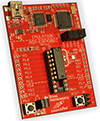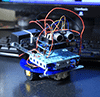







Get your microcontroller and PC to talk

(and get it done free ‘n’ easy!)
The Need
Specifications can dynamically change during the product development cycle. Bosses/clients suddenly approach us with additional requirements, which, however simple, can put us in a fix. One such requirement could be to have a PC based design interface for a standalone microcontroller project.
On many occasions, the required PC software has to just behave like a slave...
Deeply embedded design example - Logic replacement

I have always believed that some of the low-cost, low-pin count, low-resource microprocessors would make an excellent choice for the replacement of discrete logic components. In these cases the deeply embedded microprocessor would become less of a general purpose computer and more of a logic replacement, providing a prescribed function with no connection to the outside world. In a world of bigger, faster and more expensive, it is a pleasant change of pace...
Embedded Software Creation I - Methodologies

The first knowledge we need it is to know the posibilities or methodologies that exists to create Software. Each methodology is used to develop diferent types of Software. The types usually are defined by the requeriments and the diferent normative that is related to the type of device. In the next post I will explain how to find the normative@ legislation (link), and how does it work.
Let's start with methodologies. There are lot's of methodologies and so many people that develop...
VHDL tutorial - A practical example - part 2 - VHDL coding
In part 1 of this series we focused on the hardware design, including some of the VHDL definitions of the I/O characteristics of the CPLD part. In part 2, we will describe the VHDL logic of the CPLD for this design.
With any design, the first step to gather the requirements for the job at hand. From part 1 of this article, I have copied two sections that address some of the requirements for the CPLD design.
The data acquisition engine has the...
Tracing code and checking timings

Debugging resource limited systemsApplications writers that write code on large systems have it easy. Well, perhaps not easy, but certainly easier. There are some things that they don't have to worry about and there is a huge array of tools available to them when it comes time to debug. The have choices in their toolsets, lots of choices. They also have a large selection of available methods for getting debugging information out to them such as log files, proc entries, pop up dialog boxes or...
It starts with an LED
And slowly builds up from there.
I have been an embedded software engineer for many years. I was programming when I was a teenager before then, as a high school student involved in an NSF program called "National Science Foundation Summer Science Training Program (for High School Students)" or as we would rattle off during that summer of exquisite learning, NSFSSTP. We were taught to program in Fortran and taught the fundamentals of Calculus. It was a very enriching experience.
When it...
Size matters - System success depends on initial design
Too many times during the initial phases of system design, opposing interests start fighting for valuable resources, sometimes without even knowing that they are. Case in point, a development project is starting up with a very simple product. For the user interface, Engineering wants to use a very simple character based LCD display and a couple of membrane switches, while Marketing wants a graphic display with a touch screen. The cost difference between these two items is...
Software Prototyping
In my recent blog entry on the product development process (way down, near the end of the entry), I wrote the following:
"I continue these sorts of tests, building more and more complexity, until I am satisfied that my circuit is basically functional. Then, using the test code that I have created as a model, I begin to write the real software for my product. As my software grows, to complete the full functionality of my design, I sometime find it useful to drop back to my 'test software'...
Bringing up Baby - product development thoughts
Things have just started to get exciting. After months of defining, specifying and designing my latest product, I finally have semi-functional prototypes. After a few side steps during the building and bring-up process, power is applied and most of the low level functions have been verified. Soon, software will meet hardware and debugging can begin in earnest.
Before jumping in and really enjoying the fun (besides I'm now waiting for some new parts to arrive), I thought it would be nice to...
Building Linux Kernel for Desktops

Linux Development has made an amazing process in last decade. Different Linux Distributions come with specific tools which greatly ease down the build process for Linux Kernel.
Here is a good introduction to these build tools and build procedure for different Linux Distributions:
The Missing Agile Conversation

In this article, we learn about Agile practices and how they use stories as units of development. Stories consist of a brief description, one to a few sentences. They don’t contain details sufficient to allow a developer to implement them. The Agile practice is to defer details as long as possible because conditions may change. When a developer takes on a story to implement, that’s the time for them to perform the work that has been deferred. They do this by having a conversation, a series of specific discussions working closely with the various SME’s (Subject Matter Experts) who have information relevant to the story.
Embedded Software Creation I - Methodologies
The first knowledge we need it is to know the posibilities or methodologies that exists to create Software. Each methodology is used to develop diferent types of Software. The types usually are defined by the requeriments and the diferent normative that is related to the type of device. In the next post I will explain how to find the normative@ legislation (link), and how does it work.
Let's start with methodologies. There are lot's of methodologies and so many people that develop...
Get your microcontroller and PC to talk
(and get it done free ‘n’ easy!)
The Need
Specifications can dynamically change during the product development cycle. Bosses/clients suddenly approach us with additional requirements, which, however simple, can put us in a fix. One such requirement could be to have a PC based design interface for a standalone microcontroller project.
On many occasions, the required PC software has to just behave like a slave...
Tenderfoot: Recommended Reading

Twenty years ago I read Code Complete by Steve McConnell. And then read it again. And again. And again. Of all the books I have read during my career, I believe this was the book that catapulted me from a young electrical engineer to a young and aspiring embedded software engineer. So to all the ‘tenderfoots’ embarking upon an embedded systems and especially embedded software and firmware career, this entry is for you.
First, I would certainly recommend that all engineers read and read...
Embedded Programming Video Course Teaches RTOS

If you'd like to understand how a Real-Time Operating System (RTOS) really works, here is a free video course for you:
RTOS part-1: In this first lesson on RTOS you will see how to extend the foreground/background architecture from the previous lesson, so that you can have multiple background loops running seemingly simultaneously.:
RTOS part-2: In this second lesson on RTOS you will see how to automate the context switch process. Specifically, in this lesson, you will start building...
Scorchers, Part 2: Unknown Bugs and Popcorn

This is a short article about diminishing returns in the context of software releases.
Those of you who have been working professionally on software or firmware have probably faced this dilemma before. The scrum masters of the world will probably harp on terms like the Definition of Done and the Minimum Viable Product. Blah blah blah. In simple terms, how do you know when your product is ready to release? This is both an easy and a difficult question to answer.
What makes...
Building Linux Kernel for Desktops
Linux Development has made an amazing process in last decade. Different Linux Distributions come with specific tools which greatly ease down the build process for Linux Kernel.
Here is a good introduction to these build tools and build procedure for different Linux Distributions:
It starts with an LED
And slowly builds up from there.
I have been an embedded software engineer for many years. I was programming when I was a teenager before then, as a high school student involved in an NSF program called "National Science Foundation Summer Science Training Program (for High School Students)" or as we would rattle off during that summer of exquisite learning, NSFSSTP. We were taught to program in Fortran and taught the fundamentals of Calculus. It was a very enriching experience.
When it...
Embedded Software Creation II - European Normative & Legislation
In this post I will explain the European Normative. I will answer the main questions and I will be open to answer all the doubts any of you could have. Please leave a comment and I will answer if i could.
Why I need to look and accomplish some standards?The main reason is if you want to comercialize the product in the European Union, if exists any European Directive that cover the product, the product must be marked with the CE mark. For USA it work in the same way by the...
Embedded Firmware Refactoring, Optimisation and Migration

Legacy products are often based on older hardware platforms which often become under-powered or run out of memory which constrains further product development. Customers are always looking for new features and improved performance but often either don’t want to invest in new hardware or need to retain the current field population of devices.
These are ongoing challenges for any product manufacturer, but are particularly highlighted in embedded systems where product...
“Smarter” cars, unintended acceleration – and unintended consequences

In this article, I consider some recent press reports relating to embedded software in the automotive sector.
In The Times newspaper (London, 2015-10-16) the imminent arrival of Tesla cars that “use autopilot technology to park themselves and change lane without intervention from the driver” was noted.
By most definitions, the Tesla design incorporates what is sometimes called “Artificial Intelligence” (AI).Others might label it a “Smart” (or at least “Smarter”)...
Hello Android
Finally I could get Android Early SDK up and running on my Fedora Core-7 Machine.
The process was quite simple. However I had to struggle for a few days, because Fedora install the gnu version of Java and Android requires Java from Sun.
Here are the steps I had to follow:
(1) Install the eclipse IDE (if you do not have it already) with following command:
$> yum install eclipse-jdt eclipse-jdt-sdk (to be done as super user).
(2) now install the Android SDK and ADT plug-in for Eclipse...
It starts with an LED
And slowly builds up from there.
I have been an embedded software engineer for many years. I was programming when I was a teenager before then, as a high school student involved in an NSF program called "National Science Foundation Summer Science Training Program (for High School Students)" or as we would rattle off during that summer of exquisite learning, NSFSSTP. We were taught to program in Fortran and taught the fundamentals of Calculus. It was a very enriching experience.
When it...
In the beginning, there was no code…

…and it was good.
Why is it that code starts out nice and deteriorates over time?
Embedded Space & Software Development Practices
Embedded Programmers (at least the ones I know) are mostly at liberty to ignore the basic software development best practices, thanks to the simplicity of embedded applications. But, as the embedded processors are becoming more and more powerful, this situation might change soon. In coming years the embedded software applications are bound to become more complex (some embedded segments have already seen this change). Embedded programmers need to realize this inevitable change and start...
Welcome to my life!

Hi folks!
As an electronic engineer the most of my work is about making new designs where a microcontroller is present in 99.9 % of the applications. Since 2003 I am self-employed and do consultants work for different companies. I have been traveling to different parts of the world doing work for DeLaval International, a company that makes automation equipment for the dairy industry. A lot of the things I have done for them involves use of different Atmel AVR...
Assembly language is best - except when it isn’t

A look at why writing in C often produces more efficient code than hand-written assembly language.
New book on Elliptic Curve Cryptography

New book on Elliptic Curve Cryptography now online. Deep discount for early purchase. Will really appreciate comments on how to improve the book because physical printing won't happen for a few more months. Check it out here: http://mng.bz/D9NA
Remember Y2K?
There was fear that the turn of the century at the end of 1999 would cause problems with many embedded systems. There is evidence that the same issue may occur in 2038.
Configuration Management: Why Developers are Avert to
A few reasons why developers have aversion towards "Software Configuration Management Systems"
(1) They do not understand the importance of configuration management. - It is a common and logical reason. But, it is also a very dangerous sign for any organization. If their developers do not understand the importance of configuration management; then it is highly likely that developers even do not understand the other fundamentals of software development. The situation becomes worst...